I haven't updated this thing for awhile. Oh well; I've still found some stuff to read. Additionally, I've been playing Legend of Dragoon in German, without having beaten it in English previously, so I got most of the storyline in German. I'm also doing the same with Majora's Mask. I have also read Bewährung der Herzen, and learned some words like taub, stumm, Taubstumme, and Sprosse--additionally, I have an idea of what Rippelsamthosen is, even though all the German speaking people I've talked to haven't seen it.
The following is a summary of Die sieben Raben, a story from Grimms Märchen.
There was a man who had seven sons, and he had always wanted to have a daughter. He eventually had one, and sent his sons to fetch water. They were eager to see their new sister (If I read this correctly), and accidentally fell into the well. Their father got impatient waiting for them, and thought they forgot about the water over some game, and wished they were ravens--his wish came true.
Apparently, his daughter grew more and more beautiful, but her parents never told her about her brothers; they didn't want to. She found out somehow, probably from other people, and her parents finally revealed the truth. They said it wasn't her fault. She wanted to find her brothers, so she set off with a stool for when she got tired, bread for when she got hungry, and water for when she got thirsty. They also gave her a ring (possibly to remember them).
She went to the end of the world and to the sun; it was too hot and scary. She went to the moon; it was too cold, evil and cruel. She went to the stars, which sat on her stool and were nice and friendly; they told her her brothers were in Glasberg and gave her some sort of object (possibly a key) so that she could go there. She wrapped it in a cloth. When she got there, she lost it, and (If I'm reading this correctly) cut off her small finger and stuck it in the gate. She met a small dwarf there, who said her brothers were away, and to wait for them to come back. As they waited for them to come back, the dwarf laid out seven plates and goblets of food; she ate a bit from every plate and drank a bit from every goblet, and then she put her ring in the last goblet.
The seven ravens came back and found someone had eaten their food. When they found the ring and realized it was their sister, they wished they were human again. They went home happily.
Now I don't actually know if Raben is a raven, but it does say "blickte auf und sah sieben kohlenschwarze Raben auf und davon fliegen." for "...he looked up and saw seven coal black ravens (up) and flew." This at least indicates that Raben, whatever they are, can fly. "Auf einmal hörte es in der Luft ein Geschwirr und ein Geweh, da sprach das Zwerglein »jetzt kommen die Herren Raben heim geflogen«" which means "On hearing a whir and a cry in the air at once, the dwarf spoke 'The ravens are flying home now.'" (I don't actually know about "Geschwirr" or "Geweh"; I can just guess, but "geflogen" does mean they flew, and they were heard from the air, so it must at least be a bird, if it isn't a raven.
Here is another listening exercise. I took the song, Los from Rammstein and decided to find all the words in it that contained the suffix, -los, which is the equivalent of using the suffix -less in English.
Wir waren namenlos,
und ohne Lieder,
richt wortlos,
waren wir nie wieder,
etwas sanglos,
sind wir immer noch,
dafür nicht klanglos,
Man hört uns doch,
nach einen Winch dos,
Gingen sturmlos,
einfach beispiellos,
es würdet Zeit,
Los,
Sie waren sprachlos,
So sehr schockieren,
sehr ratlos,
Was zwar passiert,
etwas fassungslos,
und garantiert,
verstrecklichlos,
Das wurd setziert,
Sie sagten grundlos,
Schaden um die Noten,
So schamlos,
Das gehört verboten,
Es ist geistlos,
Was sie da probieren,
zu geschmacklos,
wie sie nur sitzieren,
Es ist hoffnungslos,
sinnlos,
hilflos,
sie sind Gott,
los,
Wir waren namenlos,
Wir haben eine Namen,
waren wortlos,
Die Worter kamen,
etwas sanglos,
sind wir immer noch,
Dafür wir klanglos,
Das hört man doch,
Die sind nicht fielerlos,
zu etwas haltlos,
Wir werden lautlos,
und schneelos,
Wir waren namenlos,
und ohne Lieder,
richt wortlos,
waren wir nie wieder,
etwas sanglos,
sind wir immer noch,
dafür nicht klanglos,
Man hört uns doch,
nach einen Winch dos,
Gingen sturmlos,
einfach beispiellos,
Für die Zeit los,
Wir waren los,
Wir waren los.
Again, there are some words I'm not entirely familiar with, or didn't hear properly.
namenlos - nameless
wortlos - wordless (additionally, this may be mistaken for wertlos, which sounds similar, for worthless.)
sanglos - songless
klanglos - without sound
sturmlos - without turmoil
beispiellos - without example
sprachlos - speechless
fassungslos - (I don't entirely know, although I would guess "incomprehensible")
verstrecklichlos - effortless, perhaps?
grundlos - without reason
schamlos - shameless
geistlos - spiritless
geschmacklos - tasteless
hoffnungslos - hopeless
sinnlos - without reason/rationality
hilflos - helpless
fielerlos - without mistake (this might also be fehlerlos, but it sounded more like "fielerlos")
haltlos - unstoppable
lautlos - without sound
schneelos - without snow
I should also say now that "los" is also an interjection meaning "go".
Friday, October 23, 2009

Friday, April 10, 2009
April 10, 2009
(This is just a notice.)
I shall be taking a second year German course next term for credit, but in the interest of knowing what I already know from that course, here is a list of all the stuff I could find that will be in it, and perhaps how much of it I already know: In future posts, I may list updates for this.
-The genitive case
(see March 30th 2009 entry.)
-Proper Names in the genitive
I have seen plenty of these throughout all the games I've played and stuff I've read. To do this, place an s on the end of the noun as you would in English, but don't add any apostrophes, unless the last letter of the noun is an s as well (and don't add the extra s).
-Prepositions with the Genitive
I may have seen some of these, but I didn't pay attention to them much.
-Adjectives after a Definite Article, Adjectives after an Indefinite Article, and Adjectives without a preceding article
I have been trying to figure out how attributive adjectives work for awhile--now I wish I hadn't read those topics though--I think they've just given me a hint as to why they're sometimes different, even though it's the exact same noun in the exact same case.
-Superlatives
Add -ste on the end unless the last letter of the adjective is a t or s (then add -est) or an eszett (then just add the -te bit). Some adjectives are irregular (gut becomes best, viel becomes meist, and wenig becomes mindest)
-Attributive Adjectives in the Comparative (and Superlative)
I'm working on this. I did already know there was a difference though.
-Adjectival nouns
Another one that escapes my attention.
-Simple Past tense
I've seen these all over. Apparently, they're irregular. A few include gab, sah, geschah, aßt, dacht, traf, fand, etc.
-The conjunction als
Als can have several different meanings. As far as I can see, they mean, than (comparative), "when" or as. I am not entirely sure if its usage requires the verb to go to the end; that can be easily remedied by finding a few examples.
-Future tense
Use werden as the main verb, and then take the other verb and stick it on the end like an auxiliary.
-How long something lasts
Use dauern for time. I think zogen can also be used.
-Relative Clauses
Use definite articles to refer to the object you wish to describe in the relative clause (use the same gender of the object). The case of the article depends on what it's doing in the relative clause. The main verb goes at the end. If the relative clause requires who, where, how, whom or to whom, then use wer, wo, wie, wem or wesen respectively. Worüber, worauf, wo-(preposition), etc. may also be used, depending on meaning.
-The Interrogative Pronoun was für
I've seen this before. And someone told me what it was. I wish they hadn't though.
-Position of nicht
I haven't paid attention to this yet.
-noch nicht/noch kein(e) nicht, mehr/kein(e)...mehr
I believe that refers to "still not yet/none yet" and not anymore/none anymore or no more.
-da and -wo compounds (if that's what they're called)
Seen these too. Just take "da" + (preposition); if the preposition begins with a vowel, add "r" after "da". So, as I said in a previous entry, darüber, darauf, dahinter, darum, dafür, darin, etc. Same with "wo"; do the same as you would for "da", but use "wo" instead of "da". The difference between both is that wo is for question words. Ie, worüber is "about what", but darüber is "about that". I think you can only use the da compound in reference to something that's already been mentioned. That's only conjecture though. I cannot say what its exact usage is for besides relative clauses and a few other sentences in which English does not require them to be translated.
I shall be taking a second year German course next term for credit, but in the interest of knowing what I already know from that course, here is a list of all the stuff I could find that will be in it, and perhaps how much of it I already know: In future posts, I may list updates for this.
-The genitive case
(see March 30th 2009 entry.)
-Proper Names in the genitive
I have seen plenty of these throughout all the games I've played and stuff I've read. To do this, place an s on the end of the noun as you would in English, but don't add any apostrophes, unless the last letter of the noun is an s as well (and don't add the extra s).
-Prepositions with the Genitive
I may have seen some of these, but I didn't pay attention to them much.
-Adjectives after a Definite Article, Adjectives after an Indefinite Article, and Adjectives without a preceding article
I have been trying to figure out how attributive adjectives work for awhile--now I wish I hadn't read those topics though--I think they've just given me a hint as to why they're sometimes different, even though it's the exact same noun in the exact same case.
-Superlatives
Add -ste on the end unless the last letter of the adjective is a t or s (then add -est) or an eszett (then just add the -te bit). Some adjectives are irregular (gut becomes best, viel becomes meist, and wenig becomes mindest)
-Attributive Adjectives in the Comparative (and Superlative)
I'm working on this. I did already know there was a difference though.
-Adjectival nouns
Another one that escapes my attention.
-Simple Past tense
I've seen these all over. Apparently, they're irregular. A few include gab, sah, geschah, aßt, dacht, traf, fand, etc.
-The conjunction als
Als can have several different meanings. As far as I can see, they mean, than (comparative), "when" or as. I am not entirely sure if its usage requires the verb to go to the end; that can be easily remedied by finding a few examples.
-Future tense
Use werden as the main verb, and then take the other verb and stick it on the end like an auxiliary.
-How long something lasts
Use dauern for time. I think zogen can also be used.
-Relative Clauses
Use definite articles to refer to the object you wish to describe in the relative clause (use the same gender of the object). The case of the article depends on what it's doing in the relative clause. The main verb goes at the end. If the relative clause requires who, where, how, whom or to whom, then use wer, wo, wie, wem or wesen respectively. Worüber, worauf, wo-(preposition), etc. may also be used, depending on meaning.
-The Interrogative Pronoun was für
I've seen this before. And someone told me what it was. I wish they hadn't though.
-Position of nicht
I haven't paid attention to this yet.
-noch nicht/noch kein(e) nicht, mehr/kein(e)...mehr
I believe that refers to "still not yet/none yet" and not anymore/none anymore or no more.
-da and -wo compounds (if that's what they're called)
Seen these too. Just take "da" + (preposition); if the preposition begins with a vowel, add "r" after "da". So, as I said in a previous entry, darüber, darauf, dahinter, darum, dafür, darin, etc. Same with "wo"; do the same as you would for "da", but use "wo" instead of "da". The difference between both is that wo is for question words. Ie, worüber is "about what", but darüber is "about that". I think you can only use the da compound in reference to something that's already been mentioned. That's only conjecture though. I cannot say what its exact usage is for besides relative clauses and a few other sentences in which English does not require them to be translated.
March 31, 2009
(The following have been deduced from Phoenix Wright: Trials and Tribulations.)

"These seeds of doubt in the heart of the judge.." (unfortunately, I don't remember the exact context of this sentence, so I can't really remember or figure out what exactly austreiben is. However, this sentence is one of many that confirm that Zweifel = doubt, and a verb based off of it, bezweifen, to doubt.)
"These seeds of doubt in the heart of the judge.." (unfortunately, I don't remember the exact context of this sentence, so I can't really remember or figure out what exactly austreiben is. However, this sentence is one of many that confirm that Zweifel = doubt, and a verb based off of it, bezweifen, to doubt.)
Monday, March 30, 2009
March 30, 2009
(The following have been deduced from Phoenix Wright: Trials and Tribulations and Myst IV: Revelations.)

"...on the campus of Harkely University" (Universität is feminine, so use "der" for genitive case. I've also seen this several times elsewhere.)


Just wanted to point out that in the second screenshot, we see "Vielleicht kann ich die Temperaturen innerhalb des Sichtgeräts simulieren, so dass ich es dann in Tomahna installieren kann.", which means "Maybe I can simulate the inner temperatures of the sight apparatus, so that I can then install it in Tomahna." ("des" indicates another genitive case, but what gender is Gerät? Now look back on the first page to "Das Sichtgerät zeigte nicht viel und ich überlegte, wie es zu verbessern sei." for "The sight apparatus did not show much, and I 'ponder' how to make it better." Gerät is neuter, and it is an apparatus.)
I now have the complete constructions for genitive cases:
Use des (or end pronouns with -es) for masculine and neuter nouns, and additionally, put "s" on the end of the noun if there isn't already one.
Use der (or end pronouns with -er) for feminine and plural nouns.
"...on the campus of Harkely University" (Universität is feminine, so use "der" for genitive case. I've also seen this several times elsewhere.)
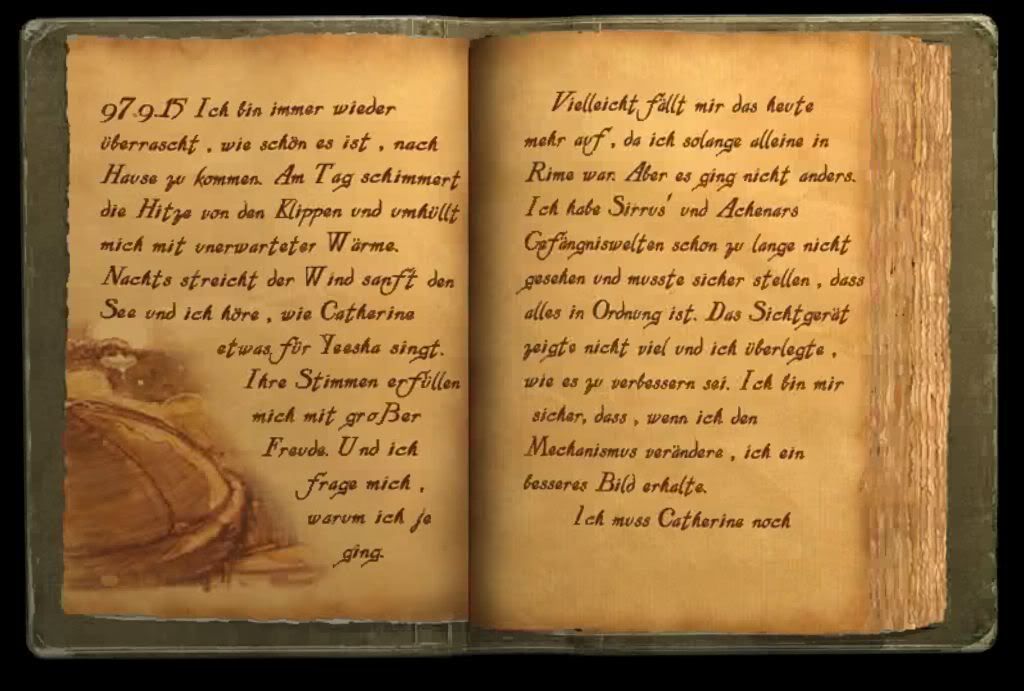
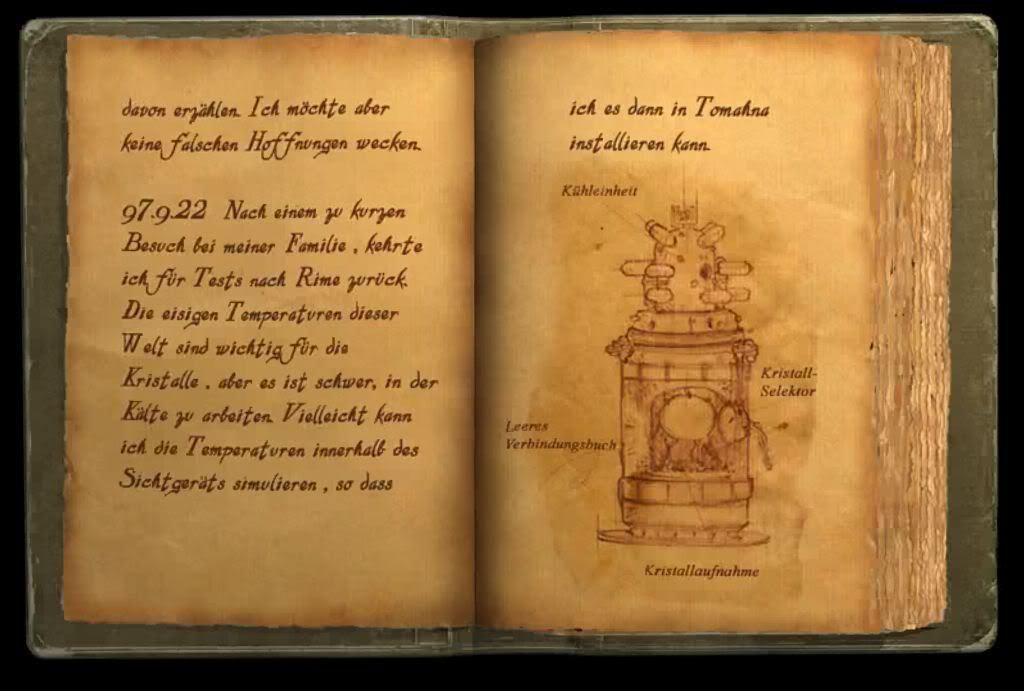
Just wanted to point out that in the second screenshot, we see "Vielleicht kann ich die Temperaturen innerhalb des Sichtgeräts simulieren, so dass ich es dann in Tomahna installieren kann.", which means "Maybe I can simulate the inner temperatures of the sight apparatus, so that I can then install it in Tomahna." ("des" indicates another genitive case, but what gender is Gerät? Now look back on the first page to "Das Sichtgerät zeigte nicht viel und ich überlegte, wie es zu verbessern sei." for "The sight apparatus did not show much, and I 'ponder' how to make it better." Gerät is neuter, and it is an apparatus.)
I now have the complete constructions for genitive cases:
Use des (or end pronouns with -es) for masculine and neuter nouns, and additionally, put "s" on the end of the noun if there isn't already one.
Use der (or end pronouns with -er) for feminine and plural nouns.
Saturday, March 28, 2009
March 29. 2009
(The following have been deduced from Phoenix Wright: Trials and Tribulations and Rammstein (listening exercise revisited.))

"Therefore...I have watched the car." (beobachten = to watch, observe. Finally!)
Weißes Fleisch (revisited); *=translation correction
Weißes Fleisch!
Du auf dem Schulhof ich zum töten bereit, ja (Yes, Schulhof is a word. If I spelt it correctly. It's a school yard.)
Und keine ihr weißt von mein Einsamkeit,
Roter Striemen auf weißer Haut,
Ich tue dir weh, und du jammest gelaut, (weh is a word; I posted about it in a previous entry.)
Jetzt hast du Angst, und ich bin so weit,
Mein schwarzes Blut, versaugt ihr das Kleid,
"White flesh!
(Now I think that says you on the schoolyard, ready to be killed.)
And none of you know about my loneliness,
Redder streams from the whiter 'body' (Well, it seems to work.)
*I hurt you, and you wimper out loud
Now you are worried, and I am so far,
My black blood soaks your dress, (I think that's what versaugt is.)"
Dein weißes Fleisch erriecht mich sooo,
Ich bin doch nur ein Jigolo (yes, that is a word)
Dein weißes Fleisch erleuchtet mich,
"Your white flesh 'pleases' me so (So I don't really know what erreichen is.)
I am only a gigolo, (I hadn't known this word before. Seriously.)
Your white flesh delights me,"
Mein schwarzes Blut, und dein weißes Fleisch,
Ich möchte immer geiler von deinem Gekreisch, (geiler is a word. I've seen it a few times, but I still haven't figured out quite what it means.)
Der Angschweiss da auf deiner weißen Stern,
Tagert in mein pranges Gehirn,
"My black blood, and your white flesh,
I would like none from your 'gekreisch' (Another word I don't know),
The 'Angschweiss' there on your white forehead (Maybe it has something to do with the worry-wrinkles on her forehead, who knows.)
It is worth in my brain (don't know pranges, or if I heard it right.)"
Dein weißes Fleisch erriecht mich sooo,
Ich bin doch nur ein Jigolo,
Mein Vater war, genau wie ich,
Dein weißes Fleisch erleuchtet mich!
"Your white flesh pleases me so,
I am only a gigolo,
My father was, exactly like me,
Your white flesh delights me!"
Jetzt hast du Angst, und ich bin so weit,
Mein Pranges das ein Acht Lösung schreit,
Dein weißes Fleisch werd Meinschaft folgt,
In meinem Himmel gibt es keinen Gott,
Ooooooh, Gott,
"Now you are worried, and I am so far,
My 'pranges' there cries 'for attention' (Not sure either.)
Your white flesh would follow 'Meinschaft' (Well, Gemeinschaft is company, but I don't know about this one.)
In my heaven, there is no god,
Oh god,"
Dein weißes Fleisch erriecht mich sooo,
Ich bin doch nur ein Jigolo,
Dein weißes Fleisch erleuchtet mich,
Mein Vater war, genau wie ich,
Dein weißes Fleisch erriecht mich sooo,
Ich bin ein trauriger Jigolo,
Dein weißes Fleisch erleuchtet, mich!
"Your white flesh pleases me so,
I am just a gigolo,
Your white flesh delights me,
My father was, exactly like me,
Your white flesh pleases me so,
I am a sadder gigolo,
Your white flesh delights me!"
"Therefore...I have watched the car." (beobachten = to watch, observe. Finally!)
Weißes Fleisch (revisited); *=translation correction
Weißes Fleisch!
Du auf dem Schulhof ich zum töten bereit, ja (Yes, Schulhof is a word. If I spelt it correctly. It's a school yard.)
Und keine ihr weißt von mein Einsamkeit,
Roter Striemen auf weißer Haut,
Ich tue dir weh, und du jammest gelaut, (weh is a word; I posted about it in a previous entry.)
Jetzt hast du Angst, und ich bin so weit,
Mein schwarzes Blut, versaugt ihr das Kleid,
"White flesh!
(Now I think that says you on the schoolyard, ready to be killed.)
And none of you know about my loneliness,
Redder streams from the whiter 'body' (Well, it seems to work.)
*I hurt you, and you wimper out loud
Now you are worried, and I am so far,
My black blood soaks your dress, (I think that's what versaugt is.)"
Dein weißes Fleisch erriecht mich sooo,
Ich bin doch nur ein Jigolo (yes, that is a word)
Dein weißes Fleisch erleuchtet mich,
"Your white flesh 'pleases' me so (So I don't really know what erreichen is.)
I am only a gigolo, (I hadn't known this word before. Seriously.)
Your white flesh delights me,"
Mein schwarzes Blut, und dein weißes Fleisch,
Ich möchte immer geiler von deinem Gekreisch, (geiler is a word. I've seen it a few times, but I still haven't figured out quite what it means.)
Der Angschweiss da auf deiner weißen Stern,
Tagert in mein pranges Gehirn,
"My black blood, and your white flesh,
I would like none from your 'gekreisch' (Another word I don't know),
The 'Angschweiss' there on your white forehead (Maybe it has something to do with the worry-wrinkles on her forehead, who knows.)
It is worth in my brain (don't know pranges, or if I heard it right.)"
Dein weißes Fleisch erriecht mich sooo,
Ich bin doch nur ein Jigolo,
Mein Vater war, genau wie ich,
Dein weißes Fleisch erleuchtet mich!
"Your white flesh pleases me so,
I am only a gigolo,
My father was, exactly like me,
Your white flesh delights me!"
Jetzt hast du Angst, und ich bin so weit,
Mein Pranges das ein Acht Lösung schreit,
Dein weißes Fleisch werd Meinschaft folgt,
In meinem Himmel gibt es keinen Gott,
Ooooooh, Gott,
"Now you are worried, and I am so far,
My 'pranges' there cries 'for attention' (Not sure either.)
Your white flesh would follow 'Meinschaft' (Well, Gemeinschaft is company, but I don't know about this one.)
In my heaven, there is no god,
Oh god,"
Dein weißes Fleisch erriecht mich sooo,
Ich bin doch nur ein Jigolo,
Dein weißes Fleisch erleuchtet mich,
Mein Vater war, genau wie ich,
Dein weißes Fleisch erriecht mich sooo,
Ich bin ein trauriger Jigolo,
Dein weißes Fleisch erleuchtet, mich!
"Your white flesh pleases me so,
I am just a gigolo,
Your white flesh delights me,
My father was, exactly like me,
Your white flesh pleases me so,
I am a sadder gigolo,
Your white flesh delights me!"
March 22, 2009
(The following have been deduced from Phoenix Wright: Trials and Tribulations.)

"True. Except the seat is full of pigeon droppings!" (Taubendreck = pigeon droppings. I think. Tauben = pigeon, Dreck = droppings. Probably. I'm not going to assume it can be used with animals other than birds.)

"I mean, were that not the case, how then does one explain the difference in time?" (Not sure about the last bit, but I noticed a different way of using "if", in particular, "if that were not true". It actually just sounds like a different tense or mood for a conditional in German that isn't the same as just a plain if sentence.)

"The case will continue, as soon as Mr. Tigre has stepped onto the witness stand." (sobald = as soon as; there's probably a construction for as [adjective] as in English which goes "so[adjective]" ie, soviel, solang, etc.)

"Hey, the pot there talking about the teakettle, little hairknot girl!" (Tiegel = teakettle or tea pot. I think. It actually looks strikingly similar to the pot calling the kettle black argument.)
"True. Except the seat is full of pigeon droppings!" (Taubendreck = pigeon droppings. I think. Tauben = pigeon, Dreck = droppings. Probably. I'm not going to assume it can be used with animals other than birds.)
"I mean, were that not the case, how then does one explain the difference in time?" (Not sure about the last bit, but I noticed a different way of using "if", in particular, "if that were not true". It actually just sounds like a different tense or mood for a conditional in German that isn't the same as just a plain if sentence.)
"The case will continue, as soon as Mr. Tigre has stepped onto the witness stand." (sobald = as soon as; there's probably a construction for as [adjective] as in English which goes "so[adjective]" ie, soviel, solang, etc.)
"Hey, the pot there talking about the teakettle, little hairknot girl!" (Tiegel = teakettle or tea pot. I think. It actually looks strikingly similar to the pot calling the kettle black argument.)
Friday, March 6, 2009
March 5, 2009
(The following have been deduced from a Rammstein song and Discworld. Unfortunately, because the text disappears after the dialog ends, I wasn't able to take the screenshots fast enough.)
Gewicht = weight
entgehen = to miss (I originally saw it as entgangen)
Jammern = lamentation
Laterne = lantern
Versteck = hideout
Ich Will
Ich will,
Ich will,
Ich will,
Ich will,
Ich will,
Ich will,
Ich will,
Ich will, ich will dass ihr mir vertraut,
Ich will, ich will dass ihr mir glaubt,
Ich will, ich will eure Blicke spüren,
Ich will, jeden Herz schlaf kontrollieren,
Ich will, ich will eure Stimmen hören,
Ich will, ich will die Ruhe spüren,
Ich will, ich will dass ihr mich gut seht,
Ich will, ich will dass ihr mich versteht,
Ich will, ich will eure wandern sehen,
Ich will, ich will euer Energie,
Ich will, ich will eure Hände sehen,
Ich will, in beifall untergehen,
"I want (repeat several times)
I want, I want that you trust me,
I want, I want that you believe me,
I want, I want to feel/sense your pulses (I guess.),
I want to control every sleeping heart (I guess, also. I think I just don't know a few words here, or I've just never seen them like this before.)
I want, I want to hear your voices,
I want, I want to feel the silence,
I want, I want that you see me well,
I want, I want that you understand me,
I want, I want to see you wander (or hike; I don't really know.),
I want, I want your energy,
I want, I want to see your hands,
I want, to sink in 'beifall' (Don't know that one.),"
Seht ihr mich,
Versteht ihr mich,
Fürt ihr mich,
Hört ihr mich,
Kannt ihr mich hören,
(Wir können nicht!)
Kannt ihr mich sehen,
(Wir können nicht!)
Kannt ihr mich fuhlen,
(Wir können nicht!)
Ich verstehe euch nicht,
Kannt ihr mich hören,
(Wir können nicht!)
Kannt ihr mich sehen,
(Wir können nicht!)
Kannt ihr mich fuhlen,
(Wir können nicht!)
Ich verstehe euch nicht,
"You see me,
You understand me,
You lead me,
You hear me,
Can you hear me,
(We cannot!) (I actually found it hard to hear the crowd, so I don't know if this is actually correct. The syllables seem to match though.)
Can you see me,
(We cannot!)
Can you feel me,
(We cannot!)
I do not understand you,"
Ich will,
Ich will,
Ich will,
Ich will,
Ich will,
Wir wollen, dass ihr uns vertraut,
Wir wollen, dass ihr uns alles glaubt,
Wir wollen, eure Hände sehen,
Wir wollen, beifall untergehen, ja,
"I want (repeat several times),
We want that you trust us,
We want that you believe us all,
We want to see your hands,
We want to sink 'beifall', yes,"
Kannt ihr mich hören,
(Wir können nicht!)
Kannt ihr mich sehen,
(Wir können nicht!)
Kannt ihr mich fuhlen,
(Wir können nicht!)
Ich verstehe euch nicht,
Kannt ihr uns hören,
(Wir können nicht!)
Kannt ihr uns sehen,
(Wir können nicht!)
Kannt ihr uns fuhlen,
(Wir können nicht!)
Wir verstehen euch nicht,
Ich will,
Ich will.
"Can you hear me,
(We cannot!)
Can you see me,
(We cannot!)
Can you feel me,
(We cannot!)
I do not understand you,
Can you hear us,
(We cannot!)
Can you see us,
(We cannot!)
Can you feel us,
(We cannot!)
We do not understand you,
I want,
I want."
Gewicht = weight
entgehen = to miss (I originally saw it as entgangen)
Jammern = lamentation
Laterne = lantern
Versteck = hideout
Ich Will
Ich will,
Ich will,
Ich will,
Ich will,
Ich will,
Ich will,
Ich will,
Ich will, ich will dass ihr mir vertraut,
Ich will, ich will dass ihr mir glaubt,
Ich will, ich will eure Blicke spüren,
Ich will, jeden Herz schlaf kontrollieren,
Ich will, ich will eure Stimmen hören,
Ich will, ich will die Ruhe spüren,
Ich will, ich will dass ihr mich gut seht,
Ich will, ich will dass ihr mich versteht,
Ich will, ich will eure wandern sehen,
Ich will, ich will euer Energie,
Ich will, ich will eure Hände sehen,
Ich will, in beifall untergehen,
"I want (repeat several times)
I want, I want that you trust me,
I want, I want that you believe me,
I want, I want to feel/sense your pulses (I guess.),
I want to control every sleeping heart (I guess, also. I think I just don't know a few words here, or I've just never seen them like this before.)
I want, I want to hear your voices,
I want, I want to feel the silence,
I want, I want that you see me well,
I want, I want that you understand me,
I want, I want to see you wander (or hike; I don't really know.),
I want, I want your energy,
I want, I want to see your hands,
I want, to sink in 'beifall' (Don't know that one.),"
Seht ihr mich,
Versteht ihr mich,
Fürt ihr mich,
Hört ihr mich,
Kannt ihr mich hören,
(Wir können nicht!)
Kannt ihr mich sehen,
(Wir können nicht!)
Kannt ihr mich fuhlen,
(Wir können nicht!)
Ich verstehe euch nicht,
Kannt ihr mich hören,
(Wir können nicht!)
Kannt ihr mich sehen,
(Wir können nicht!)
Kannt ihr mich fuhlen,
(Wir können nicht!)
Ich verstehe euch nicht,
"You see me,
You understand me,
You lead me,
You hear me,
Can you hear me,
(We cannot!) (I actually found it hard to hear the crowd, so I don't know if this is actually correct. The syllables seem to match though.)
Can you see me,
(We cannot!)
Can you feel me,
(We cannot!)
I do not understand you,"
Ich will,
Ich will,
Ich will,
Ich will,
Ich will,
Wir wollen, dass ihr uns vertraut,
Wir wollen, dass ihr uns alles glaubt,
Wir wollen, eure Hände sehen,
Wir wollen, beifall untergehen, ja,
"I want (repeat several times),
We want that you trust us,
We want that you believe us all,
We want to see your hands,
We want to sink 'beifall', yes,"
Kannt ihr mich hören,
(Wir können nicht!)
Kannt ihr mich sehen,
(Wir können nicht!)
Kannt ihr mich fuhlen,
(Wir können nicht!)
Ich verstehe euch nicht,
Kannt ihr uns hören,
(Wir können nicht!)
Kannt ihr uns sehen,
(Wir können nicht!)
Kannt ihr uns fuhlen,
(Wir können nicht!)
Wir verstehen euch nicht,
Ich will,
Ich will.
"Can you hear me,
(We cannot!)
Can you see me,
(We cannot!)
Can you feel me,
(We cannot!)
I do not understand you,
Can you hear us,
(We cannot!)
Can you see us,
(We cannot!)
Can you feel us,
(We cannot!)
We do not understand you,
I want,
I want."
Subscribe to:
Posts (Atom)
